
Scrolls, Scrolls, Scrolls!
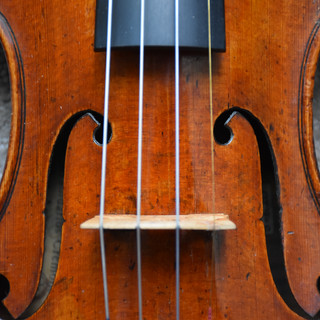

A few weeks ago, as I (Nadya) was wandering around the shop attempting to gain inspiration about what the "big" article in the next newsletter should be, I took a minute to appreciate the beautiful Mark Dearlove cello on display in our lobby with its beautiful f holes, the very cool stamp burned into the back, and its unusual and characteristic scroll. Cue inspiration strike-- SCROLLS!! We haven't talked a whole lot about scrolls in our articles over the years-- it's a part of the instrument that has basically no effect on the acoustics of the instrument, but is a place where the character of the maker can really shine.

As Eddy says, "the scroll is one of the few areas where a luthier enjoys true creative freedom. Its design has a negligible impact on the instrument's acoustics and can serve as a canvas for style, balance, and personality."
As to when the iconic "Ionic" volute became ubiquitous as the top for our bowed string instruments, there's not really one exact date. While evidence suggests that scrolls were integrated into the design of the viol-family instruments in the 1400s, craftsmen opted for human or animal carvings with equal regularity.
However, when Andrea Amati invented the violin in the mid-1500s, he used a volute for the top of the instrument, and it became the standard for violins (there are, of course, examples of violins with other decorative shapes in place of the volute, but they are the exception to the rule).

...But my goodness the variation that can be found across this "standard" shape! Take for example, three of the great masters: Andrea Amati (though it's hard to know which of the Amatis carved the scroll: there is a fair likelihood that Andrea's son Antonio carved this particular scroll), Antonio Stradivari, and Bartolomeo Giuseppe Guarneri "del Gesù".
I tried to pick a few examples above that somewhat typified each of their approaches: the elegance and precision of the Amatis, the stylistic nobility of Antonio Stradivari, and the wild personality of Del Gesù.
Scrolls can vary as much as the people who make them, and we have a number of beautiful interesting scrolls in the shop! Here are a few I've put a few side-by-side below for your viewing pleasure:

You can see the fingerprints of all the makers above: if you look closely, there are the distinct outlines of Guadagnini's square awl, and scrape marks from Nicolò Gagliano's chisel. Bartolomeo Calvarola's scroll is long and lean, the Klotz School scroll is somewhat serpentine, and on and on. The longer you look, the more interesting elements you see!
And this is just from one side: check out the personality that comes out from seeing them from the front:

There's a true coolness to these scrolls that really can't be captured through short blog post-- come in to the shop and see them first hand!


Comments